

What a Grooming-Related Skin Infection Case Can Teach a Salon
When a client reports a skin problem after grooming, two shortcuts are unhelpful: dismissing the timing, or deciding immediately that the groom caused it. The useful response is prompt care for the dog and a clear record of what happened.
One published case explains why a careful process review matters. It also shows why the type of evidence should shape what you conclude.
A case with a stronger link than timing alone
Tham and colleagues described a dog that developed rapidly progressing skin lesions, pain, lethargy and loss of appetite within 24 hours of bathing. Cultures from the lesions and the shampoo yielded Pseudomonas aeruginosa with the same pulsed-field gel electrophoresis pattern. That matching laboratory pattern supported the shampoo as the suspected source in this particular case. Read the original case report.
A matching organism pattern is more informative than “the rash appeared after the bath”. However, a single case does not tell you how often this happens, prove that a specific routine is always responsible, or allow you to identify an infection from a photograph. The report's treatment was veterinary care for that dog; it is not a treatment recipe for a salon.
The first decision concerns the dog
A dog that is painful, lethargic, not eating or developing rapidly worsening skin changes needs prompt veterinary attention. Encourage the client to contact their vet and share a factual appointment record. Do not offer a reassuring diagnosis over the phone or suggest trying another bath to see whether it settles.
If the dog is still with you, stop the relevant work and follow your incident and veterinary-contact procedure. Keep communication factual and timely.
Build a timeline before building a theory
| Record | Useful detail |
|---|---|
| Before the appointment | Client-reported changes and your observations before products or tools were used |
| During the appointment | Sequence of work, areas handled, products, dilution method and any interruption or reaction |
| Equipment | Actual blade or tool, its condition and the cleaning process used |
| After the appointment | Time the client first noticed a change, what they report and when advice was sought |
| Follow-up | Veterinary information supplied by the client, separated from your own assumptions |
Record the product name, batch information and container involved where available. “Shampoo from the blue bottle” may be insufficient to trace anything. Do not quietly discard a potentially relevant container before taking appropriate advice about whether it needs to be retained or sampled.
Review the route through the salon
Follow the actual item: where it was stored, how it was prepared, what touched it and how it moved between clean and used areas. Check the process people followed that day, not just the written procedure.
For a concern about a product or tool, remove the suspect item from routine use while you obtain appropriate advice. Label and segregate it so another person cannot unknowingly return it to service. That is a precaution while facts are established, not a declaration that you have found the cause.
AAHA's infection-control guidance distinguishes cleaning from disinfection and stresses following the disinfectant's directions, including the required contact time. For grooming tools, you must also check the tool manufacturer's material and maintenance instructions. A process suitable for a hard room surface is not automatically suitable for an assembled blade. Read the cleaning guidance.
Give spare tools a process-related purpose
A spare of a frequently used blade can help keep a workstation running while another compatible blade is undergoing its proper cleaning, drying or service routine. It should never become a reason to shorten that routine or return a questionable tool to use.
Match replacements to the actual system. The VUNRO #10 A5 Blade and #10 Ceramic D-Series Blade are different mounting systems. Our kit finder helps organise a compatible working and spare kit; contact us if the exact assembly is uncertain.
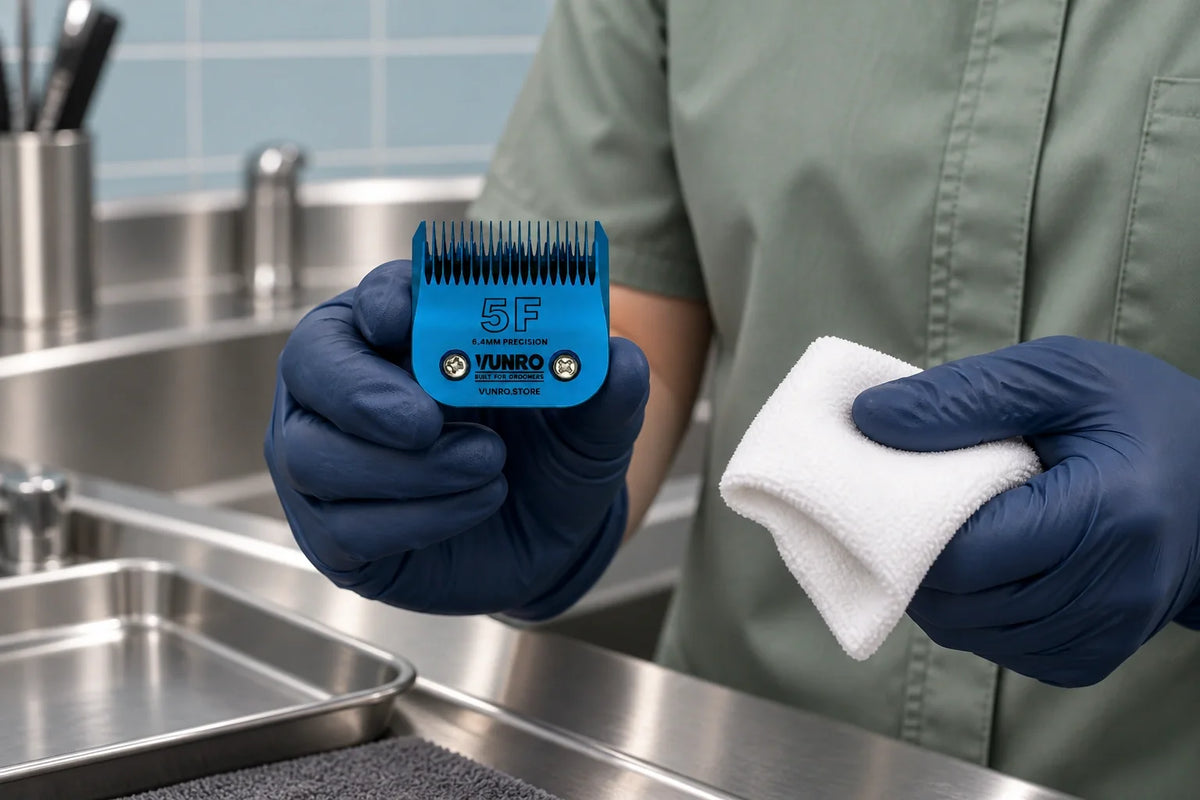
The VUNRO 5F Blue Steel A5 Blade shown in the image is another example of a tool that needs its own proper inspection and maintenance routine.
No blade material, coating or spare kit makes contaminated product safe. The product and tool routes both need attention.
Close the review with a concrete change
Decide what needs to change, who owns it and how you will check it. Examples include a clearer container record, a separate used-tool tray or a corrected preparation procedure. Explain confirmed findings to the client without turning an unresolved concern into an accusation.
Sources and scope
Tham, Jacob and Bizikova, Molecular confirmation of shampoo as the putative source of Pseudomonas aeruginosa-induced postgrooming furunculosis in a dog, Veterinary Dermatology, 2016;27:320–e80. The workflow above is a practical incident-review framework, not a diagnostic test or an estimate of infection risk.
Keep learning
More from the Blade Blog

A Faster Clipping Pass Is Not Always a Faster Groom
Read the guide →
From Used Tool to Ready Tool: Close the Gaps in the Care Process
Read the guide →


